People who grow up near water tend to find it wherever they travel. The Mississippi River gives Bellevue its character: the morning mist over the bluffs, the rhythm of the current, the way the light sits differently here than it does anywhere landlocked. That sensitivity to water as a defining feature of a place is exactly what makes Lagos, Portugal so immediately recognizable to anyone from a river town.
Lagos sits on the southwestern tip of Portugal’s Algarve coast, where the Atlantic meets a series of sandstone cliffs, hidden sea caves, and golden beaches that have been drawing travelers for decades. It’s a small city, around 30,000 people, with a long maritime history, a well-preserved old town, and access to some of the most varied coastal scenery in Europe. For anyone who loves life near the water, it’s worth a serious look.
Here are eight reasons Lagos belongs on your travel list.
1. The Coastline Is Simply Unlike Anything in North America
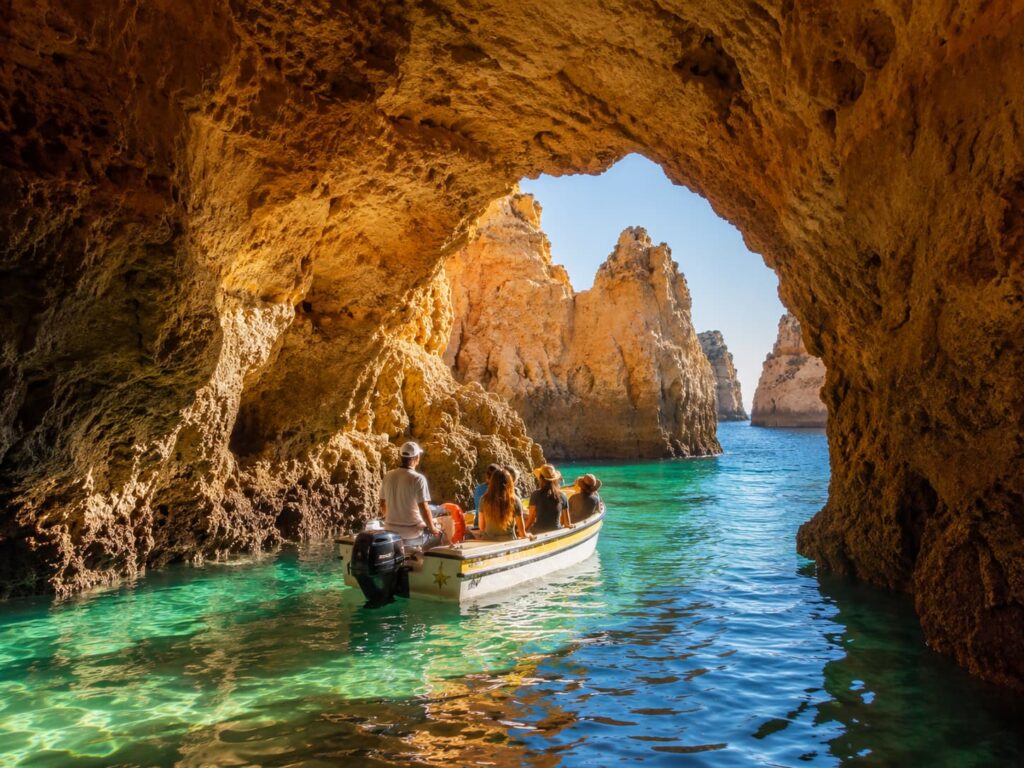
The Algarve’s defining geological feature is its Ponta da Piedade formation: a stretch of eroded sandstone cliffs just south of Lagos town that has produced a landscape of sea stacks, arches, grottos, and caves in shades of orange, ochre, and deep rust. The rock formations rise directly from the Atlantic, and the water between them is a shade of turquoise that doesn’t quite exist on most of the world’s coastlines.
Photos don’t prepare you for the scale. The cliffs at Ponta da Piedade reach around 20 metres, and the formations extend along the coast in both directions, so what you’re looking at from the water is not a single landmark but a continuous landscape of eroded stone and open sea. For anyone whose idea of a dramatic coastline was formed by the Mississippi bluffs, this is a different category of terrain entirely.
2. The Sea Caves Are Best Seen from the Water
The most distinctive feature of the Lagos coastline is its network of sea caves and grottos, accessible only by boat. Some are large enough to row through standing up. Others are narrow tunnels that open into cathedral-like chambers with natural skylights cut through the rock above. The light inside these spaces, filtered through saltwater and bounced off sandstone walls, is something photographers travel specifically to capture.
Getting into the caves requires a small boat: kayak, stand-up paddleboard, or a guided vessel that knows which passages are accessible at which tide. Operators like Lagos Boat Tours run coastal excursions specifically designed to access these formations, moving through the grottos and along the cliff faces at a pace that lets you actually absorb the landscape rather than glimpse it from a clifftop viewpoint. For anyone who has kayaked on the Mississippi, the transition to ocean kayaking in protected coastal waters is straightforward, and the payoff is significantly different.
3. Lagos Has the Character of a Real Working Town
A lot of coastal tourism destinations lose their character as they develop. Lagos has managed the balance better than most. The old town, enclosed by 14th-century walls, still has its fish market, its neighbourhood restaurants, its local bars that haven’t updated their interiors in thirty years. The marina on the waterfront is busy with fishing vessels as well as tourist boats. The weekly market draws locals as well as visitors.
This is the kind of thing that people who live in genuine communities recognize and value. Bellevue has it: the sense that a place is functioning as a place, not just as a backdrop for tourism. Lagos has managed to hold onto that quality despite significant visitor numbers, and spending time in the old town rather than on the beach gives you access to a version of the city that rewards slower, more attentive travel.
4. The Maritime History Goes Back Further Than Most American Cities
Lagos was one of the key ports of Portugal’s Age of Exploration. The explorer Gil Eanes, who was the first European to round Cape Bojador on the West African coast in 1434, sailed from Lagos. The caravels that opened Atlantic trade routes in the 15th century were built and outfitted here. Henry the Navigator, who organized and funded much of Portugal’s early exploration program, spent significant time in the region and is associated with a famous promontory just south of town.
For a town of its size, Lagos carries an outsized amount of history. The Museu Municipal on Rua General Alberto da Silveira holds archaeological finds dating back to Roman occupation of the site. The old slave market, now a museum, documents a darker chapter of the same maritime history. Taking the time to engage with this history gives the physical landscape, the harbor, the walls, the old town grid, a set of meanings that make it far more interesting than the beaches alone.
5. The Beaches Near Lagos Are Genuinely Varied
The Algarve has more beach variety within a short distance than almost anywhere in Europe. Within a few kilometres of Lagos you can choose between Meia Praia, a long flat strand on the east side of the river mouth suited to families and swimmers, and the wilder west-facing Atlantic beaches like Praia do Camilo and Praia Dona Ana, carved into the cliffs and accessible by wooden staircases.
The west-facing beaches catch bigger Atlantic swells and are popular with surfers, particularly in autumn and winter when the crowds thin and the waves build. The cliff-sheltered coves are calmer and better for swimming and snorkeling. Choosing between them depends on what you want from the day, which is a pleasant problem to have. The variety means a week in Lagos produces genuinely different daily experiences rather than the same beach repeated seven times.
6. Portugal Is One of the Most Liveable Countries in Europe
For Bellevue residents thinking about longer stays or extended travel, Portugal makes a strong case. The cost of living is low by Western European standards. The climate on the Algarve averages over 300 days of sunshine per year, with mild winters that make the region attractive outside peak summer season. English is spoken widely in Lagos, which eases the practical side of longer visits.
Portugal also ranks consistently high on global liveability and safety indices, and the country’s Golden Visa and Digital Nomad Visa programs have drawn a significant international community of remote workers and retirees, particularly to the Algarve region. The infrastructure that comes with that, good internet, healthcare access, international schools, makes it a realistic option for people considering time abroad rather than just a holiday week. The same qualities that make Bellevue attractive, a genuine community feel, proximity to nature, affordability, and a reasonable pace of life, are the qualities that draw people to Lagos for more than a short stay. Our page on liveability covers what makes a community worth putting down roots in, and Lagos checks a lot of the same boxes from a different angle.
7. The Food and Wine Scene Punches Above Its Weight
The Algarve isn’t Portugal’s most celebrated food region in the way that the Douro Valley is for wine or Lisbon is for pastry culture, but Lagos specifically has built a food scene that reflects its position at the intersection of Atlantic seafood and inland Portuguese produce. The local cataplana, a copper pressure-cooking vessel used to slow-cook fish and shellfish with tomatoes, peppers, and herbs, is worth seeking out in a proper restaurant rather than a tourist trap.
The regional wine is also underrated. Algarve wines have improved considerably over the past two decades, and the local rosé in particular is a good match for seafood eaten outdoors in warm weather. The combination of fresh fish, good wine, and a table on a cobbled street in the evening is one of those travel experiences that’s impossible to replicate and easy to underestimate before you’ve had it.
8. The Surrounding Region Rewards Exploration Beyond the Town
Lagos is a good base for a wider region that includes some of Portugal’s most varied landscapes. The Costa Vicentina to the north is one of the last undeveloped stretches of European Atlantic coastline, protected as part of the Southwest Alentejo and Vicentine Coast Natural Park. The hiking trails along the clifftop between Sagres and Odeceixe offer coastal walking that has no equivalent in southern Europe for raw, unbuilt scenery.
Sagres itself, a fishing village on the southwestern tip of the Iberian Peninsula, is worth a half-day visit for the fortress and the sense of standing at a genuine edge of the world. In the other direction, the market town of Silves, with its Moorish castle overlooking the Arade River, offers a different kind of historical depth. For anyone who uses their home town as a base for regional exploration, the way Bellevue residents use their location along the Mississippi to access the wider river valley, Lagos works the same way for the western Algarve. Our overview of life at Bellevue makes the point that geography shapes community character, and the landscape around Lagos has been shaping the people who live there for a very long time.
A Final Thought
Places built around water tend to attract people who understand what water does to a place. It sets the pace. It shapes the economy. It gives the landscape a horizon that landlocked towns don’t have. Bellevue residents, who live with the Mississippi as a daily fact of life, tend to recognize that quality in other waterfront communities fairly quickly.
Lagos has it. The harbor at dusk, the boats coming in, the light on the sandstone cliffs, the smell of the Atlantic: these are the textures of a place that takes its geography seriously. It’s worth going to see what that looks like on a different coast, in a different light, with a different history behind it.
The sea caves alone are worth the flight.